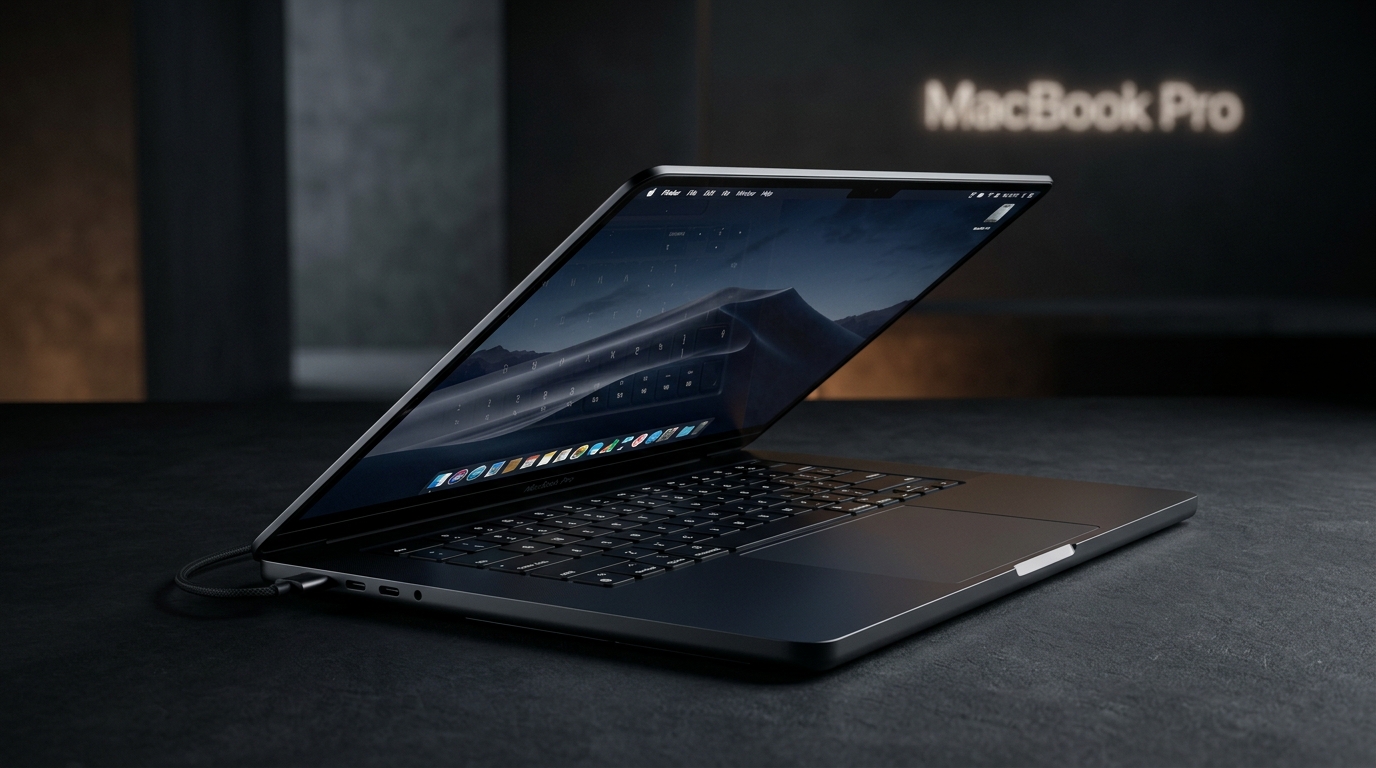
Apple MacBook Pro 16" (M3 Max)
Verdict
The definitive mobile workstation for local AI development. Powered by the M3 Max chip with a 40-core GPU and up to 128GB of unified memory running at 400GB/s, it runs massive LLMs entirely on-device without thermal throttling.
Where it wins, where it doesn't
Pros
- 400GB/s memory bandwidth eliminates LLM bottlenecks
- Up to 128GB unified RAM supports massive 70B+ models
- Unmatched battery life under heavy sustained compute
Cons
- Astronomical price at high memory configurations
- Unified memory cannot be upgraded post-purchase
Specifications
| Battery | 100-watt-hour lithium-polymer |
|---|---|
| Display | 16.2-inch Liquid Retina XDR (3456x2234, 120Hz ProMotion) |
| Cpu Cores | 16-core (12 performance, 4 efficiency) |
| Gpu Cores | 40-core (Hardware-accelerated ray tracing) |
| Architecture | ARMv8.6-A (Apple Silicon) |
| Neural Engine | 16-core (18 TOPS) |
| Unified Memory | Up to 128GB LPDDR5 |
| Memory Bandwidth | 400 GB/s |
| Fabrication Process | 3nm (TSMC N3B) |
Editorial note
The M3 Max is the machine that made serious local AI development portable. Four hundred gigabytes per second of memory bandwidth with up to 128GB unified means models that need a desktop tower elsewhere run on a laptop, on battery, without the fans becoming the loudest thing in the room. For a researcher who works in different places, that changes the shape of the working day rather than just the benchmark. Two things to be clear-eyed about. The price at high memory configurations is genuinely astronomical, and because memory is unified and soldered, under-specifying it is a decision you cannot walk back — buy the memory you will need in three years, not the memory you need today. And it remains outside CUDA, which is a non-issue for inference and an obstacle for some training work.
In-Depth Review
In-Depth Review
Four hundred gigabytes per second of unified memory bandwidth paired with up to 128GB of LPDDR5 RAM defines the Apple MacBook Pro 16" (M3 Max), transforming a mobile platform into a primary node for local AI inference. Built on TSMC's 3nm N3B process and the ARMv8.6-A architecture, the M3 Max packs a 16-core CPU (12 performance and 4 efficiency cores), a 40-core GPU featuring hardware-accelerated ray tracing, and a 16-core Neural Engine rated at 18 TOPS.
In real-world deployment, this hardware combination directly targets the primary bottleneck of large language model execution: memory throughput. Traditional mobile architectures saturate when loading high-parameter weight matrices into memory, but the 400 GB/s bandwidth feeds the 40-core GPU continuously. Coupled with the 100-watt-hour lithium-polymer battery, the system runs massive 70B+ parameter models locally without triggering aggressive thermal throttling or excessive fan noise. Visual outputs are handled by the 16.2-inch Liquid Retina XDR display, running a 3456x2234 resolution at a 120Hz ProMotion refresh rate, providing immediate clarity for both AI developers inspecting token streams and professional video or 3D editors managing dense render pipelines.
The machine wins decisively where portability meets sustained, memory-bound compute. Local AI researchers moving between field sites, laboratories, and remote environments gain the ability to evaluate heavy models on-device—workloads that typically require an AC-powered desktop tower.
However, accepting this performance profile requires navigating two major trade-offs. The system starts at USD3499, and reaching the upper limits of unified memory pushes the overall investment into astronomical territory. Because the LPDDR5 memory is integrated directly into the Apple Silicon package, post-purchase RAM upgrades are impossible. Buyers must calculate their computational requirements three years ahead rather than planning to scale hardware later. Furthermore, while on-device inference executes efficiently, the hardware remains outside the native CUDA ecosystem, creating a clear obstacle for engineers who rely on CUDA-specific libraries for model training work.
Developers strictly bound to CUDA-native training pipelines, as well as buyers whose workloads do not require localized model execution and cannot justify the steep memory configuration pricing, should skip this laptop in favor of standard cloud or desktop infrastructure.
Frequently Asked Questions
Who is Apple MacBook Pro 16" (M3 Max) for?↓
What are the drawbacks of Apple MacBook Pro 16" (M3 Max)?↓
What does Apple MacBook Pro 16" (M3 Max) do well?↓
How much does Apple MacBook Pro 16" (M3 Max) cost?↓
What is the Fathom Layer design score for Apple MacBook Pro 16" (M3 Max)?↓
Alternatives to consider
See all alternatives →Further reading
Featured badge
Building this product? Add the badge to your site to show it’s in the index.

<a href="https://fathomlayer.com/compute/premium-laptops/macbook-pro-16-m3-max" target="_blank" rel="noopener noreferrer"><img src="https://fathomlayer.com/fathom-badge.svg" alt="Featured on Fathom Layer" width="250" height="54" /></a>