
Apple MacBook Air (M5)
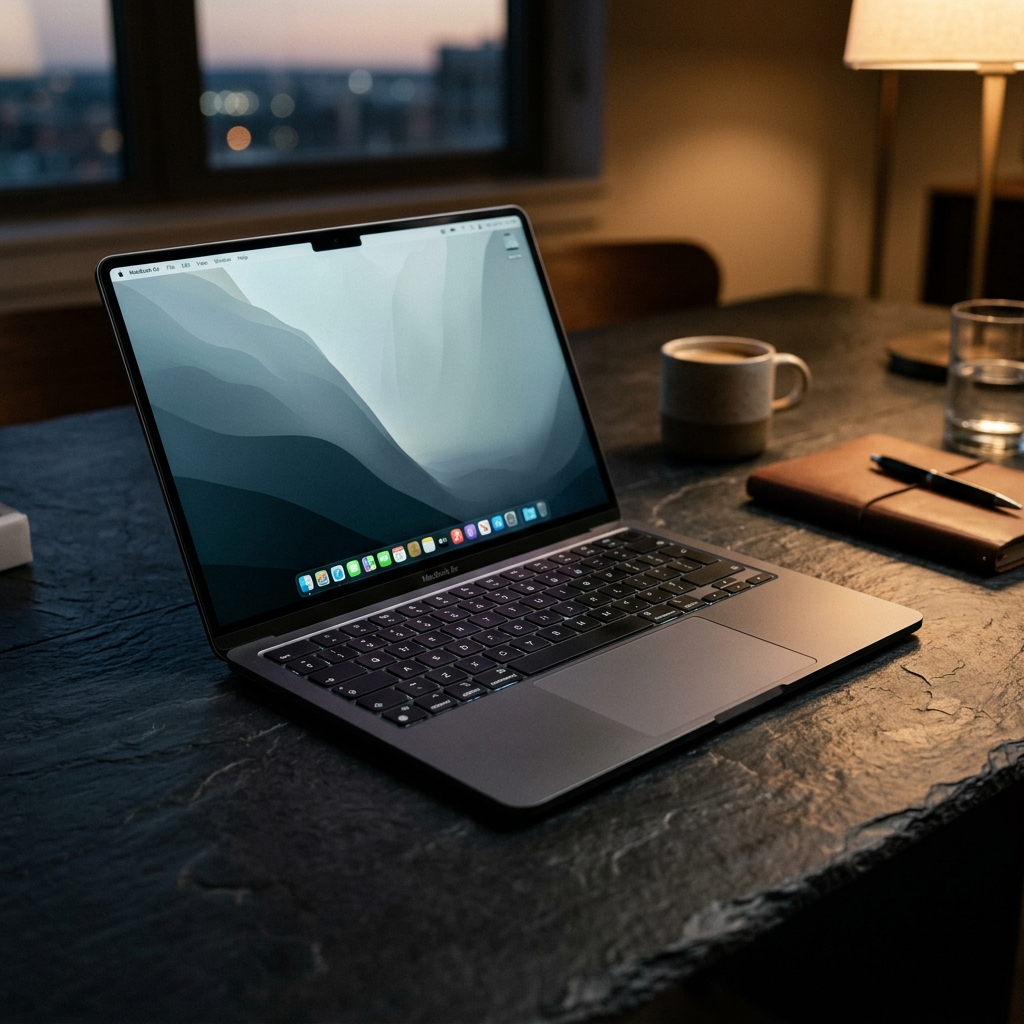
Verdict
The fanless efficiency benchmark: desktop-class work in a silent chassis, from $1,099.
Where it wins, where it doesn't
Pros
- Completely silent under normal load
- Battery life that removes charger anxiety
- Very light for the performance on offer
Cons
- Throttles under sustained load — no fan to shed heat
- Not suitable for serious local model inference
- Memory and storage fixed at purchase
Editorial note
The Air's achievement is that the machine disappears. No fan means no acoustic signal that you are working it hard, and for writing, research, browsing and ordinary development that silence is worth more than a benchmark number. Battery life follows from the same efficiency and removes the second thing people think about. Where it stops working is sustained load: without a fan, the chassis is the heatsink, so long video exports or extended local inference will throttle in a way the Pro simply does not. Treat the ceiling as real rather than theoretical. For a student, a writer or anyone whose heaviest task is a browser with sixty tabs, this is the correct machine and the Pro is a waste of money.
In-Depth Review
In-Depth Review: Apple MacBook Air (M5)
Starting at $1,099, the Apple MacBook Air (M5) is defined by its fanless thermal architecture, delivering desktop-class operational speed in a lightweight chassis without a single moving part.
Silent Efficiency in Daily Execution
By eliminating active cooling fans entirely, the M5 Air relies on its metal enclosure as the primary heatsink to dissipate thermal loads. In real-world knowledge work—such as writing, research, marketing execution, or running a web browser populated with sixty open tabs alongside text editors—the system operates in absolute silence. Because typical productivity workloads consist of brief performance bursts rather than continuous max-load generation, the machine remains completely quiet while maintaining immediate responsiveness. This high level of platform efficiency translates directly into extended battery life, removing charger anxiety during full working days and allowing the physical hardware to effectively disappear into the background of a task.
The Thermal and Hardware Ceiling
The explicit trade-off for zero acoustic output is a hard performance ceiling under continuous physical strain. Without an active fan to shed heat away from the processor, sustained heavy workloads cause the chassis to saturate thermally. During long video exports or extended local model inference, the system is forced to throttle performance to keep internal temperatures within operational boundaries. Buyers must treat this thermal boundary as a real structural limit rather than a theoretical edge case. Furthermore, hardware flexibility is restricted at the point of sale: both memory and storage are fixed at purchase and cannot be expanded later, requiring buyers to calculate their long-term capacity needs up front.
Targeted Deployment: Who Wins and Who Skips
For students, writers, marketing teams, and knowledge workers whose heaviest daily task involves browser-based workflows and document processing, the MacBook Air (M5) offers the optimal mix of portability, acoustic comfort, and compute speed. For these profiles, purchasing an actively cooled Pro model adds unnecessary cost and weight for cooling overhead that will never be engaged.
Conversely, technical buyers requiring sustained compute throughput should skip the Air entirely. Anyone planning to run serious local AI model inference, continuous code compilation loops, or extended video rendering sessions needs an actively cooled machine. Without internal fans to manage prolonged heat output, the Air's fanless chassis will inevitably throttle under those continuous engineering and media workloads.
Frequently Asked Questions
Who is Apple MacBook Air (M5) for?↓
What are the drawbacks of Apple MacBook Air (M5)?↓
What does Apple MacBook Air (M5) do well?↓
How much does Apple MacBook Air (M5) cost?↓
What is the Fathom Layer design score for Apple MacBook Air (M5)?↓
Alternatives to consider
See all alternatives →Further reading
Featured badge
Building this product? Add the badge to your site to show it’s in the index.

<a href="https://fathomlayer.com/compute/premium-laptops/apple-macbook-air-m5" target="_blank" rel="noopener noreferrer"><img src="https://fathomlayer.com/fathom-badge.svg" alt="Featured on Fathom Layer" width="250" height="54" /></a>