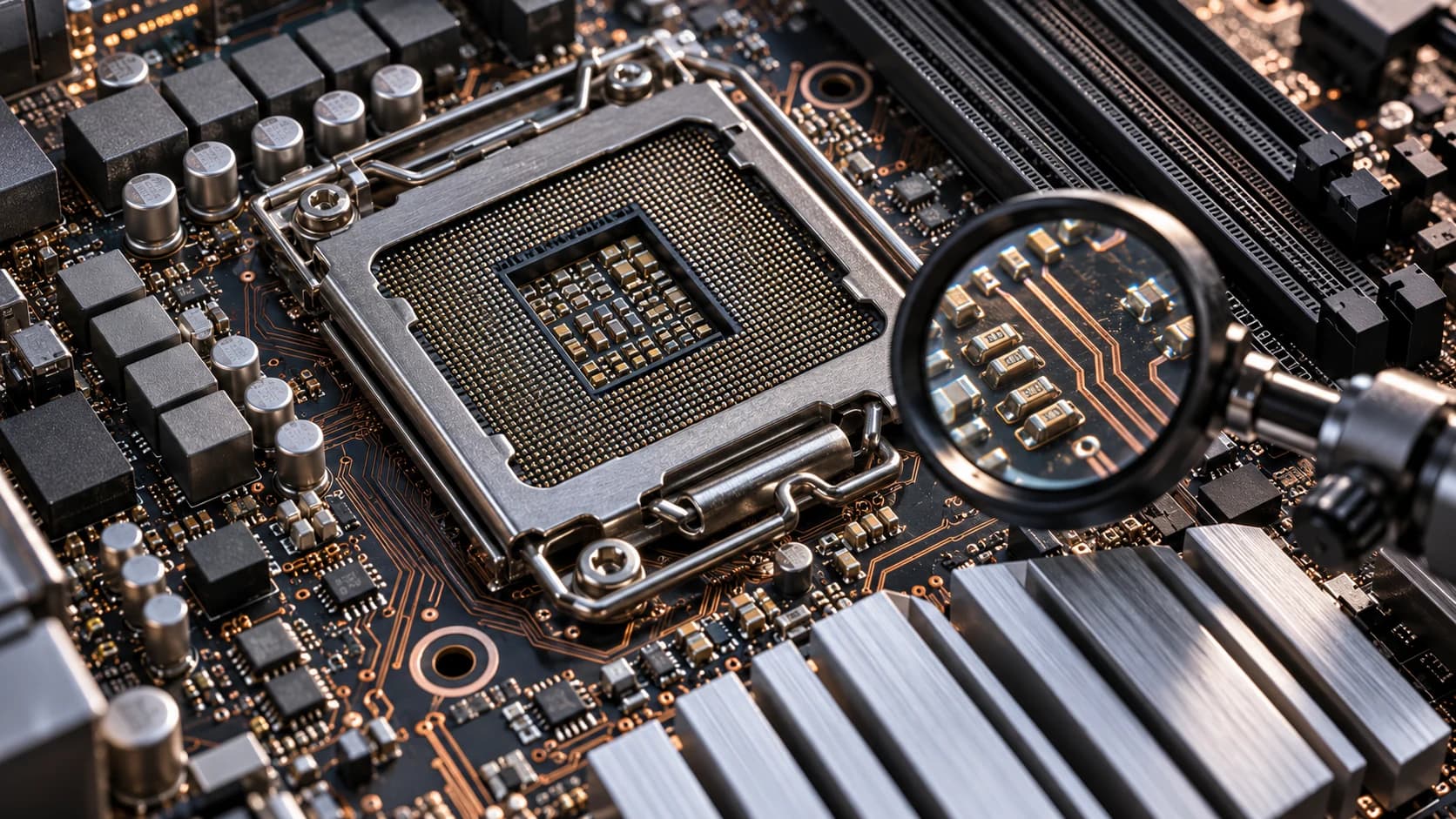
#A "2nm" node is a chip-manufacturing generation — not a physical measurement of anything on the chip. It is the industry's name for a density and efficiency tier. The IEEE's device-roadmap body (IRDS) said as much in 2020: node numbers such…
hardwaresemiconductorstsmc
Read the explanation ↗The Agent2Agent (A2A) Protocol is an open standard for letting independent AI agents — built by different teams, vendors or frameworks — discover each other and delegate work, without a bespoke integration for every pair. It is the…
aiagentsa2a
Read the explanation ↗Agentic RAG is retrieval-augmented generation in which an AI agent decides what to retrieve, from which source, and whether the results are good enough. When they are not, it retrieves again, instead of running one fixed lookup before…
agentic-airagsoftware
Read the explanation ↗AI red teaming is the practice of deliberately attacking your own AI system — with adversarial prompts, jailbreaks and edge-case inputs — to find where it breaks before someone else does. It borrows the name and the mindset from security…
securityred-teamingllm
Read the explanation ↗The context window is the maximum number of tokens — prompt plus generated output — a language model can attend to at once. Everything the model "knows" about your request lives inside it; anything pushed out of the window is simply gone.
aillmfundamentals
Read the explanation ↗FIDO2 is a set of standards for logging in with public-key cryptography instead of a password; WebAuthn is the browser API half of it; a passkey is the credential it creates. Together they are what "passwordless" means in practice, and they…
securityauthenticationfido2
Read the explanation ↗A Hall-effect keyboard switch senses a keypress magnetically instead of with a physical metal contact. A magnet in the switch moves toward a Hall sensor on the keyboard's circuit board, and the sensor reports the changing magnetic field as…
peripheralskeyboardsesports
Read the explanation ↗HNSW (Hierarchical Navigable Small World) is a graph index for approximate nearest-neighbour search: it finds vectors close to a query by walking a layered graph instead of comparing the query with every stored vector. Yu. A. Malkov and D…
softwaredatabasevector
Read the explanation ↗The KV cache stores the key and value vectors the attention mechanism has already computed for every token in the context, so the model never recomputes them. It is what makes generation after the first token fast — and it is a memory cost…
computehardwarellm
Read the explanation ↗An LLM inference engine is the software that loads a language model's weights, runs the model to generate tokens, and serves the results to applications, usually over an HTTP API. It decides how GPU memory is used, how requests are…
local-aiinferencevllm
Read the explanation ↗A local AI appliance is a self-contained computer bought mainly to run AI models on your own desk or network, rather than renting them from a cloud API. It is a descriptive label, not a standard industry term: no standards body defines it…
PrivacyLocal AIHardware
Read the explanation ↗Matter is an open connectivity standard for smart-home devices, backed by Apple, Google, Amazon and Samsung, that lets a device work with any compatible ecosystem regardless of who made it. A Matter light bulb pairs with HomeKit, Google…
smart-homematterstandards
Read the explanation ↗The Model Context Protocol (MCP) is an open standard for connecting AI models and agents to external tools, data sources and services through a single, uniform interface. Instead of writing a bespoke integration for every tool, a developer…
mcpaiagents
Read the explanation ↗MCP tool poisoning is an attack where a malicious or compromised MCP server hides instructions in the metadata a model reads — tool descriptions, parameter schemas or tool output — instead of in the user's prompt. The model treats that text…
mcpsecurityagents
Read the explanation ↗MicroLED is a display technology in which every pixel, or every subpixel, is its own microscopic inorganic LED, so the panel makes its own light without a backlight. In wearables it matters in two different forms: as a direct-view screen on…
displayswearablesar
Read the explanation ↗Multi-head Latent Attention (MLA) and DeepSeekMoE are the two architecture choices that let DeepSeek-V3 run as a 671-billion-parameter model while activating only about 37 billion parameters per token. Both are set out in the DeepSeek-V3…
aimodelsmoe
Read the explanation ↗An NPU (neural processing unit) is a fixed-function accelerator built into a modern SoC to run neural-network maths — matrix multiplication and convolution — at a fraction of the power a CPU or GPU would use. In 2026 laptop and phone chips…
hardwareailaptops
Read the explanation ↗On-device AI means running a model's inference on the phone, laptop or other device in your hands, instead of sending the input to a model on a remote server. The model's weights are stored on the device, and the prompt, image or audio is…
aiprivacylocal-ai
Read the explanation ↗Prompt injection is an attack where text that reaches a language model is interpreted as an instruction instead of as content — because the model reads instructions and data through the same channel and cannot reliably tell them apart. It…
securityllmprompt-injection
Read the explanation ↗Quantization stores a model's weights at lower numeric precision — 8, 4, or even 2 bits instead of 16 — trading a small, measurable quality loss for a large cut in memory and bandwidth. It is the technique that moved 70B-class models from…
computemodelsoptimization
Read the explanation ↗Secrets management is the practice of creating, storing, distributing, rotating, revoking and auditing the credentials software needs to run — API keys, database passwords, tokens, SSH keys, certificates — so they never sit in plaintext in…
securitysecrets-managementinfrastructure
Read the explanation ↗SLM stands for small language model: a language model built to run with far less memory and compute than a frontier large language model (LLM), often on a laptop, phone or single GPU. There is no official parameter cutoff that makes a model…
edge-ailocal-aisoftware
Read the explanation ↗A ternary LLM constrains every weight to one of three values — −1, 0 or +1 — which needs about 1.58 bits of storage each (log₂3 ≈ 1.58), against 16 bits for a standard model. The idea comes from Microsoft Research's paper "The Era of 1-bit…
aimodelsquantization
Read the explanation ↗Unified memory is a design in which the CPU and GPU share one pool of system memory instead of each having its own, so the GPU can work on data without it first being copied into separate video memory. Apple introduced it to the Mac with…
local-aimemoryhardware
Read the explanation ↗VRAM (video RAM) is the memory on a graphics card, and for running a language model locally it is usually the first limit you hit: the model's weights and its KV cache have to fit in it, or part of the model has to run from slower system…
local-aimemoryhardware
Read the explanation ↗WebNN is a browser API that lets web pages run neural-network inference on the device's native accelerators — the NPU, GPU or CPU — through the operating system's own ML runtime. It is the missing piece for fast, private, offline AI on the…
webnnstandardsedge-ai
Read the explanation ↗Tokens per second (tok/s) is the rate at which a language model processes or produces tokens, and in our reading, a single tok/s figure quoted for a local model usually means generation speed: how fast new tokens appear after the first one…
local-aiaibenchmarks
Read the explanation ↗