
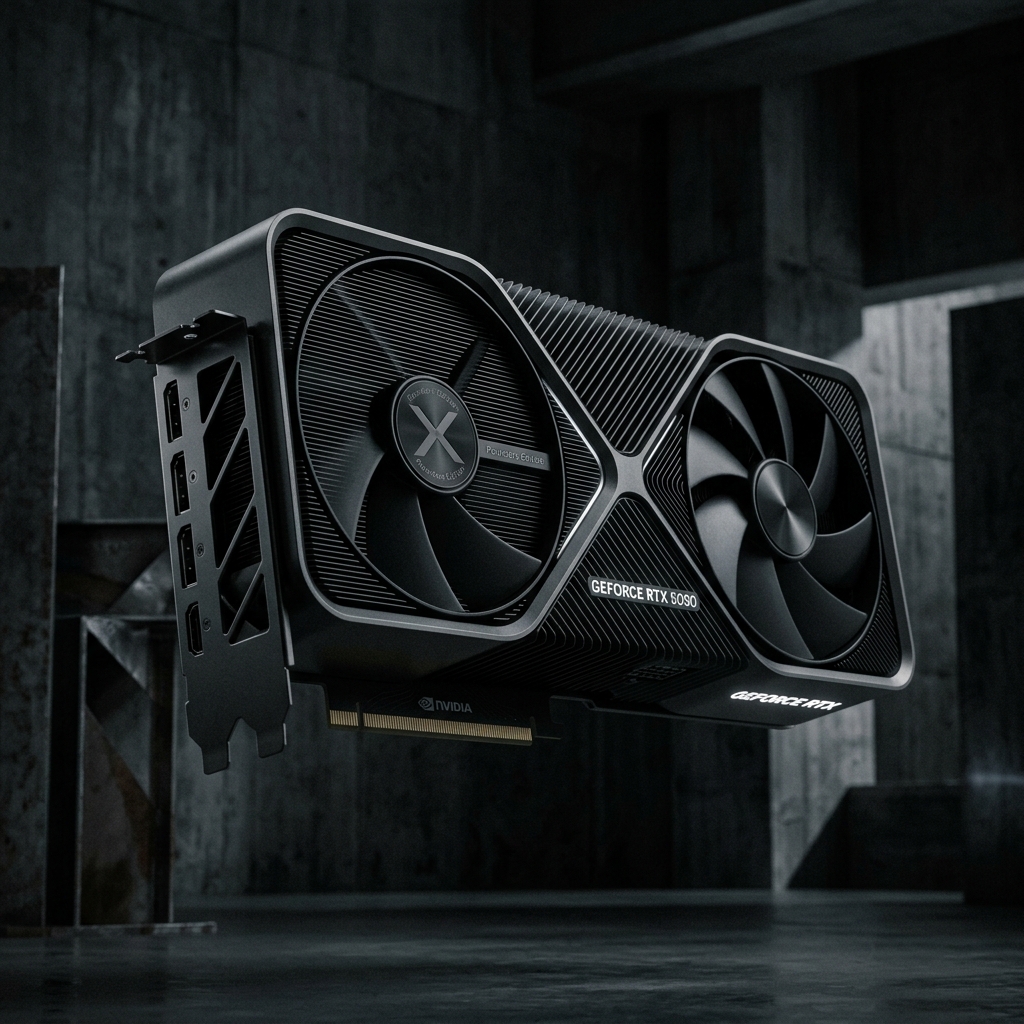
Nvidia GeForce RTX 5090 (32GB)
Verdict
The fastest consumer card available, with 32GB of GDDR7 — and the power bill to match.
Where it wins, where it doesn't
Pros
- 32GB GDDR7 — runs 70B-class models quantised on a single card
- Fastest consumer silicon available
- Avoids the complexity of a multi-GPU build
Cons
- Roughly double the 5080's price for far less than double the performance
- 600W-class power delivery dictates case and PSU choices
- Poor value for anything that is not memory-bound
Specifications
| Memory | 32GB GDDR7 |
|---|---|
| Cuda Cores | 21760 |
| Memory Bus | 512-bit |
| Architecture | Blackwell |
| Recommended Psu | 1000W |
| Memory Bandwidth | 1792 GB/s |
| Total Graphics Power | 575W |
Editorial note
Thirty-two gigabytes is what you are buying. It is the difference between running a 70B-class model quantised on one card and not running it at all, and no amount of speed on a 16GB card substitutes for it. If local inference on large open models is the actual job, this is the shortest path that does not involve wrangling multiple GPUs. The costs are equally concrete: a price that is roughly double the 5080 for well under double the frames, a 600W-class power connector, and a thermal load that dictates your case and probably your PSU. Buy it if the model you need does not fit anywhere else. Buying it for gaming is buying the wrong end of a steep curve.
In-Depth Review
In-Depth Analysis
The Nvidia GeForce RTX 5090 is defined by its 32GB of GDDR7 memory, a specific capacity threshold that determines whether 70B-class open-weight models can be run quantised on a single card. Built on Nvidia’s Blackwell architecture and released in 2025, the card pairs this high-capacity frame buffer with a wide 512-bit memory bus to deliver 1,792 GB/s of memory bandwidth alongside 21,760 CUDA cores.
In practical deployment, these specifications translate into a dedicated tool for memory-bound workloads. Large language model inference relies heavily on throughput to feed processor arrays; by delivering 1,792 GB/s of bandwidth, the card prevents the computational stalls common to narrower interfaces. For local AI labs and developers, the primary advantage of the 32GB allocation is operational simplicity. It allows teams to deploy quantised 70B-class models on a single slot, completely bypassing the physical real estate, interface latencies, and software wrangling inherent to multi-GPU configurations. As the fastest consumer silicon currently available, it represents the shortest direct path to executing large open models locally.
That single-card capability comes with heavy hardware and system-level trade-offs. Operating at a total graphics power of 575W, the RTX 5090 relies on a 600W-class power delivery connection and mandates a minimum recommended 1000W power supply unit. The resulting thermal load dictates strict requirements for system chassis volume and airflow management, meaning the card cannot simply be dropped into a standard workstation without planning for power supply and enclosure constraints.
Financial trade-offs are just as pronounced. With a starting price of USD 1,999, the RTX 5090 commands roughly double the price of the RTX 5080, yet delivers far less than double the frame rates or compute scaling. Buyers using applications that are not strictly VRAM-bound will find the card yields exceptionally poor value on a performance-per-dollar basis.
Consequently, users looking for traditional gaming performance or workloads limited purely by raw compute rather than memory capacity should skip this card entirely. The RTX 5090 is engineered specifically for buyers for whom memory capacity is the absolute binding constraint, and where avoiding a complex multi-GPU setup justifies both the steep price premium and the card's heavy power envelope.
Frequently Asked Questions
Who is Nvidia GeForce RTX 5090 (32GB) for?↓
What are the drawbacks of Nvidia GeForce RTX 5090 (32GB)?↓
What does Nvidia GeForce RTX 5090 (32GB) do well?↓
How much does Nvidia GeForce RTX 5090 (32GB) cost?↓
What is the Fathom Layer design score for Nvidia GeForce RTX 5090 (32GB)?↓
Alternatives to consider
See all alternatives →Further reading
Featured badge
Building this product? Add the badge to your site to show it’s in the index.

<a href="https://fathomlayer.com/compute/local-ai-workstations/nvidia-geforce-rtx-5090" target="_blank" rel="noopener noreferrer"><img src="https://fathomlayer.com/fathom-badge.svg" alt="Featured on Fathom Layer" width="250" height="54" /></a>