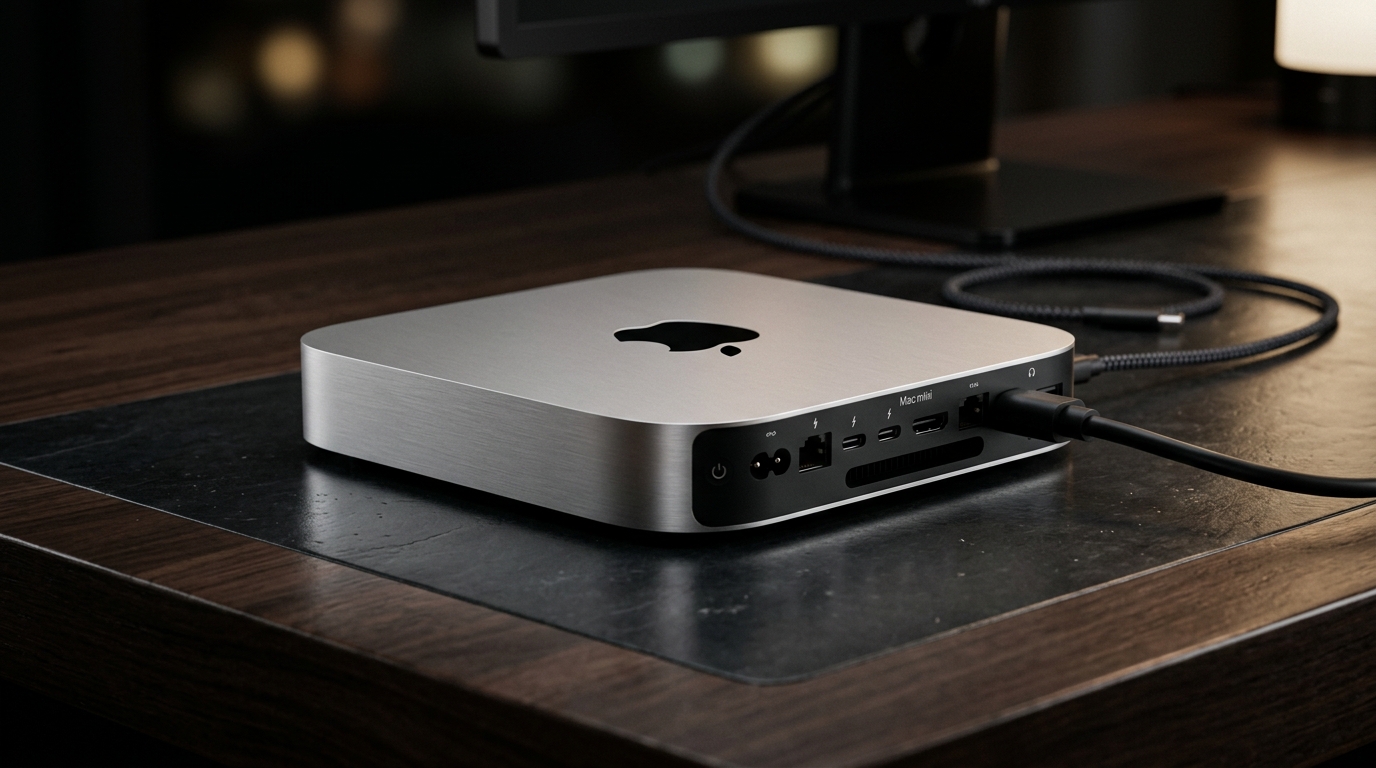
Mac Mini M4 Pro (64GB)
Verdict
Compact unified-memory system built on the Apple M4 Pro with 64 GB shared between CPU and GPU. Runs Gemma 3 27B and Qwen3 30B-A3B at roughly 35-50 tokens/s while operating near-silently — the mid tier of this index for local AI work.
Where it wins, where it doesn't
Pros
- 64GB unified memory accessible by GPU
- Near-silent operation at 100% load
- Class-leading performance-per-watt
Cons
- Zero post-purchase upgradeability
- Lacks native CUDA ecosystem support
Specifications
| Chip | Apple M4 Pro |
|---|---|
| Runs | Gemma 3 27B, Qwen3 30B-A3B |
| Throughput | 35-50 tok/s |
| Unified memory | 64 GB |
Editorial note
The M4 Pro with 64GB unified memory represents the most cost-effective path to running large models (70B+ parameters) locally. Because the integrated GPU can access the entire 64GB memory pool, it outperforms comparably priced discrete PC builds in raw memory capacity, despite lacking native CUDA ecosystem support.
In-Depth Review
Apple Mac Mini M4 Pro (64GB) Analysis
The Apple Mac Mini M4 Pro centers its local AI performance on 64 GB of unified memory shared directly between the Apple M4 Pro CPU and integrated GPU. Serving as the mid tier of our local AI hardware index, this unified memory design enables the integrated GPU to access the entire 64 GB memory pool without discrete VRAM allocation limits. Consequently, this system represents the most cost-effective path available to run large models—specifically 70B+ parameter LLMs—on local hardware.
Real-World Use and Memory Efficiency
In practical inference tasks, the M4 Pro translates its shared architecture into steady execution speeds for mid-sized open-weights models. The system runs Gemma 3 27B and Qwen3 30B-A3B at roughly 35-50 tokens/s. Because the integrated GPU draws from the full 64 GB memory allocation, the Mac Mini outperforms comparably priced discrete PC builds in raw memory capacity dedicated to storing model weights.
This throughput is paired with class-leading performance-per-watt. Even under a sustained 100% computational load during heavy generation tasks, the Mac Mini operates near-silently. For engineers working in quiet home office environments, this thermal and acoustic efficiency eliminates the fan noise typically associated with running high-load local AI workloads on desktop rigs.
Trade-offs and Ecosystem Limits
Despite its memory capacity advantages per dollar, technical buyers must account for significant platform trade-offs. The primary software limitation is the lack of native CUDA ecosystem support. Workflows or software stacks built specifically around NVIDIA's CUDA runtime cannot run natively on Apple's architecture, requiring alternative software paths.
Furthermore, the Mac Mini features zero post-purchase upgradeability. The 64 GB unified memory is integrated directly into the system, meaning the computational and memory headroom is locked at purchase with no path to expand physical memory as model footprints grow over time.
Buyer Guidance
The Mac Mini M4 Pro (64GB) wins decisively for users needing to run 70B+ parameter models locally on a budget while maintaining near-silent acoustic performance in quiet home office settings. However, buyers whose software environments strictly require native CUDA support, or those who demand modular, upgradeable hardware, should skip this system.
Frequently Asked Questions
Who is Mac Mini M4 Pro (64GB) for?↓
What are the drawbacks of Mac Mini M4 Pro (64GB)?↓
What does Mac Mini M4 Pro (64GB) do well?↓
How much does Mac Mini M4 Pro (64GB) cost?↓
What is the Fathom Layer design score for Mac Mini M4 Pro (64GB)?↓
Alternatives to consider
See all alternatives →Further reading
Featured badge
Building this product? Add the badge to your site to show it’s in the index.

<a href="https://fathomlayer.com/compute/local-ai-workstations/mac-mini-m4-pro-64gb" target="_blank" rel="noopener noreferrer"><img src="https://fathomlayer.com/fathom-badge.svg" alt="Featured on Fathom Layer" width="250" height="54" /></a>