Versus Engine
GeForce RTX 5070 vs Minisforum MS-S1 Max
Recorded specs, strengths and limitations for GeForce RTX 5070 and Minisforum MS-S1 Max, side by side. Check the evidence and your requirements before deciding.
Pricing
Not verified here
Current prices and availability are not verified in this summary. Check regional offers and required accessories before buying.
Recorded design scores
GeForce RTX 5070: Not recorded · Minisforum MS-S1 Max: 9.2
Editorial design scores are not performance benchmarks or proof of suitability. Review the full records and your requirements.
Feature notes on record
- GeForce RTX 5070: 16 GB GDDR7 memory
- Minisforum MS-S1 Max: 128GB unified memory in a mini-PC chassis
GeForce RTX 5070
GeForce RTX 5070 graphics card with 16 GB GDDR7 memory and 133 TFLOPS of processing power.
Where it wins, where it doesn't
Pros
- Supports up to four monitors for multi-display setups
- 16 GB GDDR7 memory for large-scale projects and gaming
- Advanced AI and ray tracing capabilities with DLSS 4 and RTX Remix
Cons
- Requires a 300W power supply, limiting compatibility with some systems
- Physical dimensions may restrict installation in compact cases
- Does not support NVIDIA NVLink for multi-GPU configurations
Specifications
- TDP250 W
- 3D-Guided Neural RenderingDLSS 5
- AI computing power—
- AnnouncedJan 6th, 2025
- APU—
- ArchitectureBlackwell 2.0
- AtomMan G1 PRO—
- AtomMan G7 Pro—
- AtomMan G7 Pt—
- AtomMan G7 TI/G7 TI SE—
- Bandwidth672.0 GB/s
- Bluetooth—
- Bus InterfacePCIe 5.0 x16
- Card Dimensions / LengthVaries by manufacturer
- Card Dimensions / Slots2-Slot
- Card Dimensions / Width112 mm
- Chassis Design—
- Chip PackageFCBGA-3064
- Cooling—
- DEG2 OCuLink eGPU Dock—
- Density118.3M / mm²
- Deployment—
- Display Support / HDCP2.3
- Display Support / Maximum Digital Resolution (1)4K at 480Hz or 8K at 165Hz with DSC
- Display Support / Multi Monitorup to 4 (4)
- Display Support / Standard Display Connectors3x DisplayPort (2) , 1x HDMI (3)
- Driver SupportActive
- EliteMini UM780 XTX—
- Expansion—
- FoundryTSMC
- FP1630.87 TFLOPS (1:1)
- FP3230.87 TFLOPS
- FP4493.9 TFLOPS
- FP6246.9 TFLOPS
- FP64482.3 GFLOPS (1:64)
- FP8123.5 TFLOPS
- GenerationGeForce 50
- GPU Engine Specs / NVIDIA CUDA ® Cores8960
- GPU Engine Specs / Ray Tracing Cores4th Generation 133 TFLOPS
- GPU Engine Specs / Shader CoresBlackwell
- GPU Engine Specs / Tensor Cores (AI)5th Generation 1406 AI TOPS
- GPU VariantGB205-300-A1
- Graphics—
- Graphics FeaturesDirectX 12 Ultimate (12_2), OpenGL 4.6, OpenCL 3.0, Vulkan 1.4, CUDA 12.0, Shader Model 6.9
- Height115 mm
- INT8246.9 TOPS
- L1 Cache128 KB (per SM)
- L2 Cache48 MB
- Launch Price549 USD
- Memory—
- Memory Architecture—
- Memory Bus192 bit
- Memory Clock1750 MHz
- Memory Size12 GB
- Memory Specs / Memory Interface Width256-bit
- Memory Specs / Standard Memory Config16 GB GDDR7
- Memory TypeGDDR7
- MINISFORUM 129i7—
- MINISFORUM 795S7—
- MINISFORUM BD790i—
- MINISFORUM BD795i SE—
- MINISFORUM BD795M—
- MINISFORUM DEG1 eGPU Dock—
- MINISFORUM eGPU Docking Station MGA1—
- MINISFORUM MGP01 Game Controller—
- MINISFORUM MKB i83—
- MINISFORUM MS-01—
- MINISFORUM MS-A1—
- MINISFORUM N5 MAX—
- MINISFORUM TB4-01 12 in 1 Thunderbolt™ 4 Dock—
- MS-A2—
- N5—
- N5 AIR—
- N5 Pro—
- NPU—
- NVDEC6th Gen
- NVENC9th Gen
- Outputs1x HDMI 2.1b, 3x DisplayPort 2.1b
- Package Size47.4 mm × 35.8 mm
- Pixel Rate201.0 GPixel/s
- Power Connectors1x 16-pin
- Power Supply—
- PredecessorGeForce 40
- Process Size5 nm
- Process Type4N FinFET
- ProductionActive
- Ray ReconstructionDLSS 4.5
- Release DateMar 4th, 2025
- ROPs80
- RT Cores48
- Shading Units6144
- Slot WidthDual-slot
- SM Count48
- SuccessorGeForce 60
- Suggested PSU600 W
- Super ResolutionDLSS 4.5, FSR 3.1.5, XeSS 3
- Technology Support / AV1 DecodeYes
- Technology Support / AV1 EncodeYes
- Technology Support / CUDA Capability12.0
- Technology Support / Game Ready DriversYes
- Technology Support / Microsoft DirectX ® 12 UltimateYes
- Technology Support / NVIDIA AppYes
- Technology Support / NVIDIA ArchitectureBlackwell
- Technology Support / NVIDIA BroadcastYes
- Technology Support / NVIDIA Decoder (NVDEC)1x Sixth Generation
- Technology Support / NVIDIA DLSSDLSS 4 Super Resolution DLAA Ray Reconstruction Frame Generation Multi Frame Generation
- Technology Support / NVIDIA Encoder (NVENC)2x Ninth Generation
- Technology Support / NVIDIA FreeStyleYes
- Technology Support / NVIDIA G-SYNC ®Yes
- Technology Support / NVIDIA GPU Boost ™Yes
- Technology Support / NVIDIA HighlightsYes
- Technology Support / NVIDIA NVLink ™ (SLI-Ready)No
- Technology Support / NVIDIA OmniverseYes
- Technology Support / NVIDIA ReflexReflex 2 Low Latency Mode Frame Warp (Coming Soon)
- Technology Support / NVIDIA ShadowPlayYes
- Technology Support / NVIDIA Studio DriversYes
- Technology Support / PCI Express Gen 5Yes
- Technology Support / Photo ModeYes
- Technology Support / Ray TracingYes
- Technology Support / RTX RemixYes
- Technology Support / VR ReadyYes
- Technology Support / Vulkan 1.4, OpenGL 4.6Yes
- Tensor Cores5th Gen
- Texture Rate482.3 GTexel/s
- Thermal and Power Specs / Maximum GPU Temperature (in C)88
- Thermal and Power Specs / Required System Power (W) (5)750
- Thermal and Power Specs / Supplementary Power Connectors2x PCIe 8-pin cables (adapter in box) OR 300 W or greater PCIe Gen 5 cable
- Thermal and Power Specs / Total Graphics Power (W)300
- TMUs192
- Transistors31.1 billion
- UM880 Plus—
- USB—
- VDPAUFeature Set K
- Weight1101 g
- Wi-Fi—
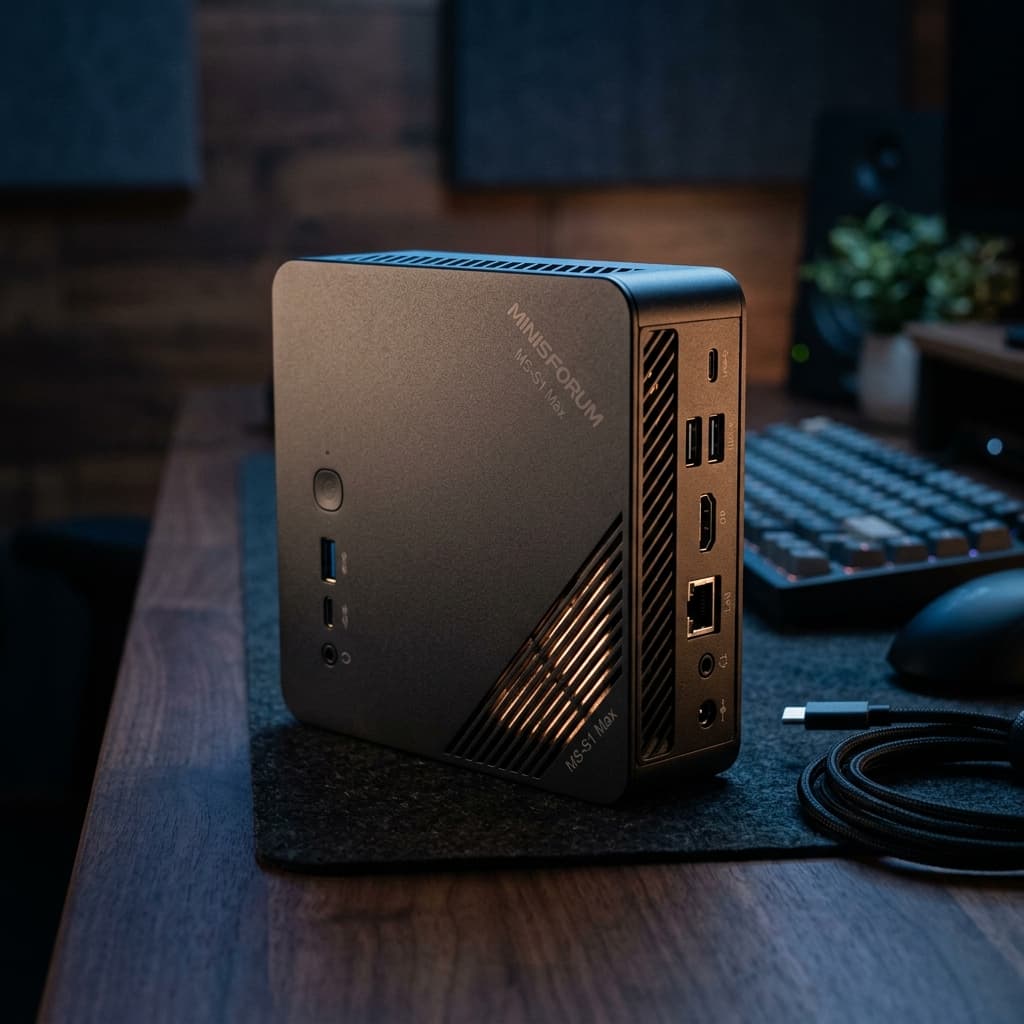
Minisforum MS-S1 Max
AMD Strix Halo in a mini-PC, with 128GB of soldered LPDDR5x unified memory.
Where it wins, where it doesn't
Pros
- 128GB unified memory in a mini-PC chassis
- Runs models that would otherwise need multiple GPUs
- Low power draw for the capability
Cons
- Memory is soldered — no upgrade path
- Token generation well below a discrete GPU
- Pointless for models that already fit in consumer VRAM
Specifications
- TDP130W sustained
- 3D-Guided Neural Rendering—
- AI computing power126 TOPS
- Announced—
- APUAMD Ryzen AI Max+ 395
- Architecture—
- AtomMan G1 PRO32GB RAM+1TB SSD
- AtomMan G7 ProIntel Core i9 14900HX / 32GB RAM+1TB SSD
- AtomMan G7 PtAMD Ryzen™9 7945HX / 32GB RAM+ 1TB SSD
- AtomMan G7 TI/G7 TI SEIntel® Core™ i9 14900HX(G7 Ti) / Barebone / UK
- Bandwidth—
- BluetoothBluetooth 5.4
- Bus Interface—
- Card Dimensions / Length—
- Card Dimensions / Slots—
- Card Dimensions / Width—
- Chassis Designslide-out chassis
- Chip Package—
- Coolingaerospace-grade aluminum chassis, pure copper baseplate, six heat pipes, dual centrifugal fans, phase-change cooling material
- DEG2 OCuLink eGPU DockBlack
- Density—
- Deploymentrack-mountable, supports multi-system clusters
- Display Support / HDCP—
- Display Support / Maximum Digital Resolution (1)—
- Display Support / Multi Monitor—
- Display Support / Standard Display Connectors—
- Driver Support—
- EliteMini UM780 XTXGold / 32GB RAM+1TB SSD / US
- ExpansionPCIe x16
- Foundry—
- FP16—
- FP32—
- FP4—
- FP6—
- FP64—
- FP8—
- Generation—
- GPU Engine Specs / NVIDIA CUDA ® Cores—
- GPU Engine Specs / Ray Tracing Cores—
- GPU Engine Specs / Shader Cores—
- GPU Engine Specs / Tensor Cores (AI)—
- GPU Variant—
- GraphicsAMD Radeon 8060S
- Graphics Features—
- Height—
- INT8—
- L1 Cache—
- L2 Cache—
- Launch Price—
- Memoryup to 128 GB LPDDR5x-8000 MT/s with 256 GB/s bandwidth
- Memory ArchitectureUMA unified memory architecture
- Memory Bus—
- Memory Clock—
- Memory Size—
- Memory Specs / Memory Interface Width—
- Memory Specs / Standard Memory Config—
- Memory Type—
- MINISFORUM 129i7AMD Ryzen™ 9 7940HX (790S7) / BAREBONE (NO OS/RAM/SSD) / EU
- MINISFORUM 795S7AMD Ryzen™ 9 7945HX (795S7) / BAREBONE / UK
- MINISFORUM BD790iAMD Ryzen™ 9 7940HX-BD790i SE / Mini-ITX Form Factor(170x170x1.6mm)
- MINISFORUM BD795i SEAMD Ryzen™ 9 7945HX-BD795i SE / Mini-ITX Form Factor(170x170x1.6mm)
- MINISFORUM BD795MAMD Ryzen™ 9 7945HX / M-ATX Form Factor(240х220х1.6mm)
- MINISFORUM DEG1 eGPU DockeGPU Dock
- MINISFORUM eGPU Docking Station MGA1AMD Radeon™ 7600M XT
- MINISFORUM MGP01 Game ControllerGame Controller
- MINISFORUM MKB i83Obsidian Black
- MINISFORUM MS-01Intel® Core™ i5-12600H / Barebone / UK
- MINISFORUM MS-A1without CPU
- MINISFORUM N5 MAXAMD Ryzen™ AI Max+ 395 / 128GB LPDDR5x + 128GB OS Storage / US
- MINISFORUM TB4-01 12 in 1 Thunderbolt™ 4 DockThunderbolt™ 4 Dock
- MS-A280 / 32GB RAM + 1TB SSD
- N5AMD Ryzen™ 7 255 / 16G DDR5 + 128G OS Storage
- N5 AIRAMD Ryzen™ 7 255 / 16GB DDR5+64GB OS Storage
- N5 ProAMD Ryzen™ AI 9 HX PRO 370 / 16G DDR5 + 128G OS Storage
- NPU50 TOPS
- NVDEC—
- NVENC—
- Outputs—
- Package Size—
- Pixel Rate—
- Power Connectors—
- Power Supply320W high-efficiency internal power supply certified by CCC, FCC, UL, CE, and UKCA
- Predecessor—
- Process Size—
- Process Type—
- Production—
- Ray Reconstruction—
- Release Date—
- ROPs—
- RT Cores—
- Shading Units—
- Slot Width—
- SM Count—
- Successor—
- Suggested PSU—
- Super Resolution—
- Technology Support / AV1 Decode—
- Technology Support / AV1 Encode—
- Technology Support / CUDA Capability—
- Technology Support / Game Ready Drivers—
- Technology Support / Microsoft DirectX ® 12 Ultimate—
- Technology Support / NVIDIA App—
- Technology Support / NVIDIA Architecture—
- Technology Support / NVIDIA Broadcast—
- Technology Support / NVIDIA Decoder (NVDEC)—
- Technology Support / NVIDIA DLSS—
- Technology Support / NVIDIA Encoder (NVENC)—
- Technology Support / NVIDIA FreeStyle—
- Technology Support / NVIDIA G-SYNC ®—
- Technology Support / NVIDIA GPU Boost ™—
- Technology Support / NVIDIA Highlights—
- Technology Support / NVIDIA NVLink ™ (SLI-Ready)—
- Technology Support / NVIDIA Omniverse—
- Technology Support / NVIDIA Reflex—
- Technology Support / NVIDIA ShadowPlay—
- Technology Support / NVIDIA Studio Drivers—
- Technology Support / PCI Express Gen 5—
- Technology Support / Photo Mode—
- Technology Support / Ray Tracing—
- Technology Support / RTX Remix—
- Technology Support / VR Ready—
- Technology Support / Vulkan 1.4, OpenGL 4.6—
- Tensor Cores—
- Texture Rate—
- Thermal and Power Specs / Maximum GPU Temperature (in C)—
- Thermal and Power Specs / Required System Power (W) (5)—
- Thermal and Power Specs / Supplementary Power Connectors—
- Thermal and Power Specs / Total Graphics Power (W)—
- TMUs—
- Transistors—
- UM880 Plus32GB RAM+1TB SSD
- USBUSB4 v2 (80 Gbps)
- VDPAU—
- Weight—
- Wi-FiWi-Fi 7
Specifications
| Specification | GeForce RTX 5070 | Minisforum MS-S1 Max |
|---|---|---|
| TDP | 250 W | 130W sustained |
| 3D-Guided Neural Rendering | DLSS 5 | — |
| AI computing power | — | 126 TOPS |
| Announced | Jan 6th, 2025 | — |
| APU | — | AMD Ryzen AI Max+ 395 |
| Architecture | Blackwell 2.0 | — |
| AtomMan G1 PRO | — | 32GB RAM+1TB SSD |
| AtomMan G7 Pro | — | Intel Core i9 14900HX / 32GB RAM+1TB SSD |
| AtomMan G7 Pt | — | AMD Ryzen™9 7945HX / 32GB RAM+ 1TB SSD |
| AtomMan G7 TI/G7 TI SE | — | Intel® Core™ i9 14900HX(G7 Ti) / Barebone / UK |
| Bandwidth | 672.0 GB/s | — |
| Bluetooth | — | Bluetooth 5.4 |
| Bus Interface | PCIe 5.0 x16 | — |
| Card Dimensions / Length | Varies by manufacturer | — |
| Card Dimensions / Slots | 2-Slot | — |
| Card Dimensions / Width | 112 mm | — |
| Chassis Design | — | slide-out chassis |
| Chip Package | FCBGA-3064 | — |
| Cooling | — | aerospace-grade aluminum chassis, pure copper baseplate, six heat pipes, dual centrifugal fans, phase-change cooling material |
| DEG2 OCuLink eGPU Dock | — | Black |
| Density | 118.3M / mm² | — |
| Deployment | — | rack-mountable, supports multi-system clusters |
| Display Support / HDCP | 2.3 | — |
| Display Support / Maximum Digital Resolution (1) | 4K at 480Hz or 8K at 165Hz with DSC | — |
| Display Support / Multi Monitor | up to 4 (4) | — |
| Display Support / Standard Display Connectors | 3x DisplayPort (2) , 1x HDMI (3) | — |
| Driver Support | Active | — |
| EliteMini UM780 XTX | — | Gold / 32GB RAM+1TB SSD / US |
| Expansion | — | PCIe x16 |
| Foundry | TSMC | — |
| FP16 | 30.87 TFLOPS (1:1) | — |
| FP32 | 30.87 TFLOPS | — |
| FP4 | 493.9 TFLOPS | — |
| FP6 | 246.9 TFLOPS | — |
| FP64 | 482.3 GFLOPS (1:64) | — |
| FP8 | 123.5 TFLOPS | — |
| Generation | GeForce 50 | — |
| GPU Engine Specs / NVIDIA CUDA ® Cores | 8960 | — |
| GPU Engine Specs / Ray Tracing Cores | 4th Generation 133 TFLOPS | — |
| GPU Engine Specs / Shader Cores | Blackwell | — |
| GPU Engine Specs / Tensor Cores (AI) | 5th Generation 1406 AI TOPS | — |
| GPU Variant | GB205-300-A1 | — |
| Graphics | — | AMD Radeon 8060S |
| Graphics Features | DirectX 12 Ultimate (12_2), OpenGL 4.6, OpenCL 3.0, Vulkan 1.4, CUDA 12.0, Shader Model 6.9 | — |
| Height | 115 mm | — |
| INT8 | 246.9 TOPS | — |
| L1 Cache | 128 KB (per SM) | — |
| L2 Cache | 48 MB | — |
| Launch Price | 549 USD | — |
| Memory | — | up to 128 GB LPDDR5x-8000 MT/s with 256 GB/s bandwidth |
| Memory Architecture | — | UMA unified memory architecture |
| Memory Bus | 192 bit | — |
| Memory Clock | 1750 MHz | — |
| Memory Size | 12 GB | — |
| Memory Specs / Memory Interface Width | 256-bit | — |
| Memory Specs / Standard Memory Config | 16 GB GDDR7 | — |
| Memory Type | GDDR7 | — |
| MINISFORUM 129i7 | — | AMD Ryzen™ 9 7940HX (790S7) / BAREBONE (NO OS/RAM/SSD) / EU |
| MINISFORUM 795S7 | — | AMD Ryzen™ 9 7945HX (795S7) / BAREBONE / UK |
| MINISFORUM BD790i | — | AMD Ryzen™ 9 7940HX-BD790i SE / Mini-ITX Form Factor(170x170x1.6mm) |
| MINISFORUM BD795i SE | — | AMD Ryzen™ 9 7945HX-BD795i SE / Mini-ITX Form Factor(170x170x1.6mm) |
| MINISFORUM BD795M | — | AMD Ryzen™ 9 7945HX / M-ATX Form Factor(240х220х1.6mm) |
| MINISFORUM DEG1 eGPU Dock | — | eGPU Dock |
| MINISFORUM eGPU Docking Station MGA1 | — | AMD Radeon™ 7600M XT |
| MINISFORUM MGP01 Game Controller | — | Game Controller |
| MINISFORUM MKB i83 | — | Obsidian Black |
| MINISFORUM MS-01 | — | Intel® Core™ i5-12600H / Barebone / UK |
| MINISFORUM MS-A1 | — | without CPU |
| MINISFORUM N5 MAX | — | AMD Ryzen™ AI Max+ 395 / 128GB LPDDR5x + 128GB OS Storage / US |
| MINISFORUM TB4-01 12 in 1 Thunderbolt™ 4 Dock | — | Thunderbolt™ 4 Dock |
| MS-A2 | — | 80 / 32GB RAM + 1TB SSD |
| N5 | — | AMD Ryzen™ 7 255 / 16G DDR5 + 128G OS Storage |
| N5 AIR | — | AMD Ryzen™ 7 255 / 16GB DDR5+64GB OS Storage |
| N5 Pro | — | AMD Ryzen™ AI 9 HX PRO 370 / 16G DDR5 + 128G OS Storage |
| NPU | — | 50 TOPS |
| NVDEC | 6th Gen | — |
| NVENC | 9th Gen | — |
| Outputs | 1x HDMI 2.1b, 3x DisplayPort 2.1b | — |
| Package Size | 47.4 mm × 35.8 mm | — |
| Pixel Rate | 201.0 GPixel/s | — |
| Power Connectors | 1x 16-pin | — |
| Power Supply | — | 320W high-efficiency internal power supply certified by CCC, FCC, UL, CE, and UKCA |
| Predecessor | GeForce 40 | — |
| Process Size | 5 nm | — |
| Process Type | 4N FinFET | — |
| Production | Active | — |
| Ray Reconstruction | DLSS 4.5 | — |
| Release Date | Mar 4th, 2025 | — |
| ROPs | 80 | — |
| RT Cores | 48 | — |
| Shading Units | 6144 | — |
| Slot Width | Dual-slot | — |
| SM Count | 48 | — |
| Successor | GeForce 60 | — |
| Suggested PSU | 600 W | — |
| Super Resolution | DLSS 4.5, FSR 3.1.5, XeSS 3 | — |
| Technology Support / AV1 Decode | Yes | — |
| Technology Support / AV1 Encode | Yes | — |
| Technology Support / CUDA Capability | 12.0 | — |
| Technology Support / Game Ready Drivers | Yes | — |
| Technology Support / Microsoft DirectX ® 12 Ultimate | Yes | — |
| Technology Support / NVIDIA App | Yes | — |
| Technology Support / NVIDIA Architecture | Blackwell | — |
| Technology Support / NVIDIA Broadcast | Yes | — |
| Technology Support / NVIDIA Decoder (NVDEC) | 1x Sixth Generation | — |
| Technology Support / NVIDIA DLSS | DLSS 4 Super Resolution DLAA Ray Reconstruction Frame Generation Multi Frame Generation | — |
| Technology Support / NVIDIA Encoder (NVENC) | 2x Ninth Generation | — |
| Technology Support / NVIDIA FreeStyle | Yes | — |
| Technology Support / NVIDIA G-SYNC ® | Yes | — |
| Technology Support / NVIDIA GPU Boost ™ | Yes | — |
| Technology Support / NVIDIA Highlights | Yes | — |
| Technology Support / NVIDIA NVLink ™ (SLI-Ready) | No | — |
| Technology Support / NVIDIA Omniverse | Yes | — |
| Technology Support / NVIDIA Reflex | Reflex 2 Low Latency Mode Frame Warp (Coming Soon) | — |
| Technology Support / NVIDIA ShadowPlay | Yes | — |
| Technology Support / NVIDIA Studio Drivers | Yes | — |
| Technology Support / PCI Express Gen 5 | Yes | — |
| Technology Support / Photo Mode | Yes | — |
| Technology Support / Ray Tracing | Yes | — |
| Technology Support / RTX Remix | Yes | — |
| Technology Support / VR Ready | Yes | — |
| Technology Support / Vulkan 1.4, OpenGL 4.6 | Yes | — |
| Tensor Cores | 5th Gen | — |
| Texture Rate | 482.3 GTexel/s | — |
| Thermal and Power Specs / Maximum GPU Temperature (in C) | 88 | — |
| Thermal and Power Specs / Required System Power (W) (5) | 750 | — |
| Thermal and Power Specs / Supplementary Power Connectors | 2x PCIe 8-pin cables (adapter in box) OR 300 W or greater PCIe Gen 5 cable | — |
| Thermal and Power Specs / Total Graphics Power (W) | 300 | — |
| TMUs | 192 | — |
| Transistors | 31.1 billion | — |
| UM880 Plus | — | 32GB RAM+1TB SSD |
| USB | — | USB4 v2 (80 Gbps) |
| VDPAU | Feature Set K | — |
| Weight | 1101 g | — |
| Wi-Fi | — | Wi-Fi 7 |
More comparisons in this category
Questions about GeForce RTX 5070 vs Minisforum MS-S1 Max
- What is the difference between GeForce RTX 5070 and Minisforum MS-S1 Max?
- On record, GeForce RTX 5070's main strength is: Supports up to four monitors for multi-display setups. Minisforum MS-S1 Max's is: 128GB unified memory in a mini-PC chassis.
- What are the downsides of GeForce RTX 5070 and Minisforum MS-S1 Max?
- GeForce RTX 5070: Requires a 300W power supply, limiting compatibility with some systems. Minisforum MS-S1 Max: Memory is soldered — no upgrade path.