
Software decision profile
Supabase
Postgres you actually own, with the developer experience of a managed backend and none of the Firebase lock-in. Expects you to know some SQL.

Explore the trade-offs.
Where it stands outFull power of raw PostgreSQLExplore strengths ↗Close details ↑
- Excellent developer experience and documentation
- No vendor lock-in compared to Firebase
What to weighRequires basic SQL knowledge for complex tasksExplore limitations ↗Close details ↑
- Self-hosting can be challenging to manage
- Edge functions sometimes have cold start delays
Best suited toIndie hackers, Next.js developers, Full-stack startups
What you actually get.
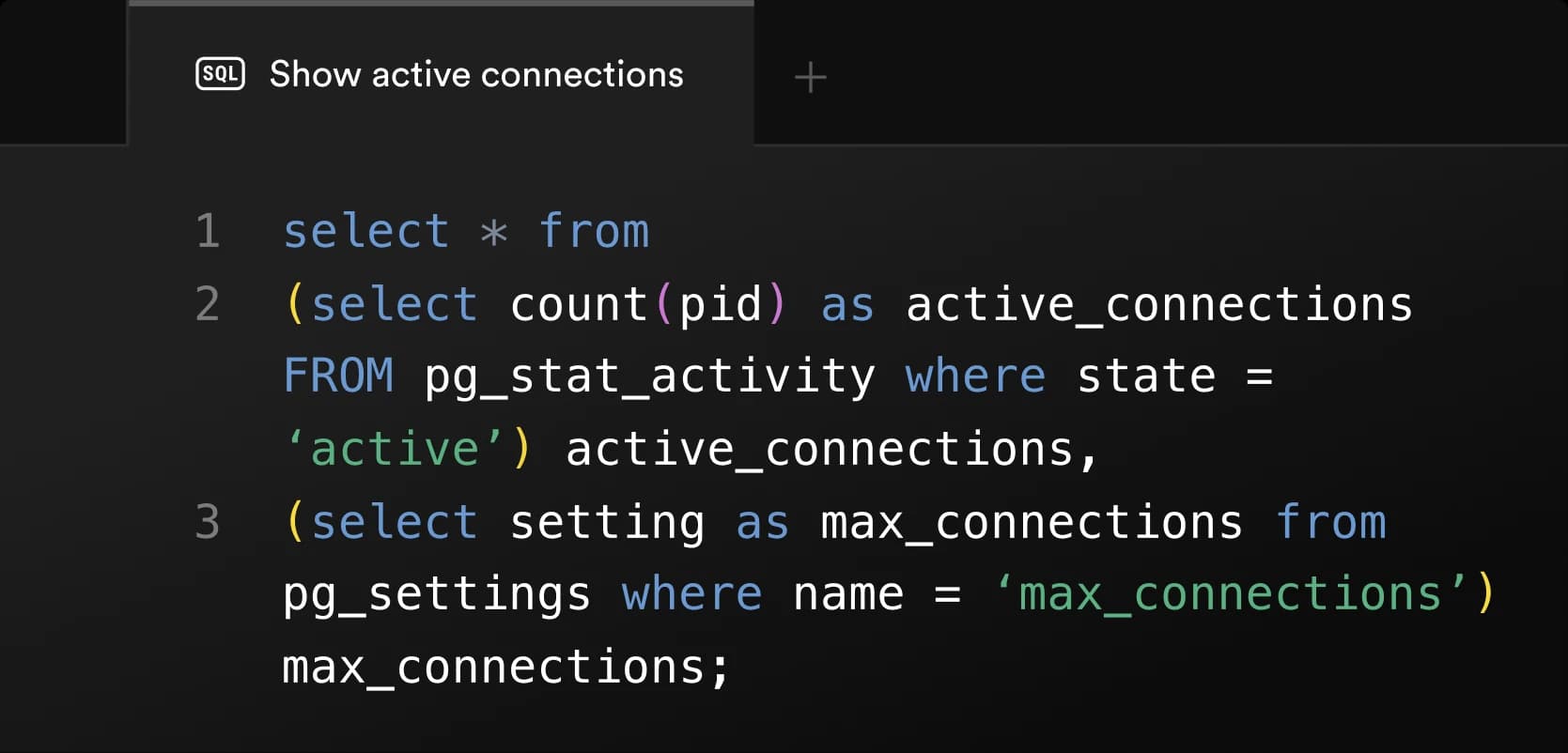
A view of the SQL Editor and a map of the platform’s documented building blocks. The image is provided by Supabase; this is not a hands-on test.

Where it wins, where it doesn't
Pros
- Full power of raw PostgreSQL
- Excellent developer experience and documentation
- No vendor lock-in compared to Firebase
Cons
- Requires basic SQL knowledge for complex tasks
- Self-hosting can be challenging to manage
- Edge functions sometimes have cold start delays
Editorial note
Every Supabase project is a full Postgres database with authentication, data APIs, edge functions, realtime, storage and vector embeddings layered on top, and the core is Postgres, which is portable. The free tier suits experiments rather than production: as of September 2026, free projects pause after one week of inactivity and are capped at two active projects, and production use starts on the paid Pro plan. It rewards teams comfortable with SQL; those wanting a schemaless document store will find the model less forgiving.
Capabilities, limitations and fit.
In-Depth Review
Supabase is a backend-as-a-service built on raw PostgreSQL rather than a proprietary datastore, which is the whole pitch: you get auth, realtime, storage and auto-generated APIs, but the database underneath is standard Postgres you can query directly, migrate elsewhere, or self-host.
Why developers pick it over Firebase
- No vendor lock-in — it is Postgres; your data and schema are portable.
- Excellent developer experience and documentation.
- pgvector support makes it a credible vector store for RAG without a second service.
The trade-offs
- Complex tasks need real SQL knowledge — the abstraction is thinner than Firebase's.
- Self-hosting is genuinely challenging to operate.
- Edge functions can have cold-start latency.
Who should use it
Indie hackers, Next.js developers and full-stack startups who want managed infrastructure without giving up SQL or portability. If you want a fully abstracted, never-touch-the-database experience, Firebase asks less of you.
Frequently Asked Questions
Who is Supabase for?↓
What are the drawbacks of Supabase?↓
What does Supabase do well?↓
How much does Supabase cost?↓
Like-for-like peers are still being documented.
Our developer tools category spans different jobs. We only show alternatives here when they can replace the same kind of backend. Browse the full category ↗
Featured badge
Building this product? Add the badge to your site to show it’s in the index.

<a href="https://fathomlayer.com/intelligence/developer-tools/supabase" target="_blank" rel="noopener noreferrer"><img src="https://fathomlayer.com/fathom-badge.svg" alt="Featured on Fathom Layer" width="250" height="54" /></a>