
Versus Engine
Jetson Orin Nano Super Developer Kit vs NVIDIA Vera Rubin NVL72
Specs, price and the one trade-off that actually decides it — Jetson Orin Nano Super Developer Kit against NVIDIA Vera Rubin NVL72, side by side.
Cheaper to start
Tie
Both start at a similar price.
Best ecosystem
Tie
Neither lists native integrations.
Standout
Jetson Orin Nano Super Developer Kit
67 INT8 TOPS AI performance
Jetson Orin Nano Super Developer Kit
Jetson Orin Nano Super Developer Kit with 67 INT8 TOPS AI performance
Where it wins, where it doesn't
Pros
- High AI performance with 67 INT8 TOPS
- Supports SD card and external NVMe storage
- Robust GPU with 1024 CUDA cores and 32 tensor cores
Cons
- Power consumption ranges from 7W to 25W, requiring a specific power supply
Specifications
- AI Performance67 INT8 TOPS
- Configuration—
- CPU6-core Arm® Cortex™-A78AE v8.2 64-bit CPU 1.5MB L2 + 4MB L3
- CPU Core Count—
- CPU Memory—
- FP16/BF16³—
- FP32—
- FP64—
- FP8/FP6 Training³—
- GPUNVIDIA Ampere architecture with 1024 CUDA cores and 32 tensor cores
- GPU Memory | Bandwidth—
- GPUs in 100 MW¹—
- Inlet Temp—
- Memory8GB 128-bit LPDDR5 102 GB/s
- Networking Bandwidth (Scale-Out)´—
- NVFP4 Inference²—
- NVFP4 Training³—
- NVIDIA NVLink—
- NVLink Bandwidth—
- NVLink-C2C Bandwidth—
- Power7W–25W
- StorageSupports SD card slot and external NVMe
- TF32³—
- Total NVIDIA + HBM4 Chips—
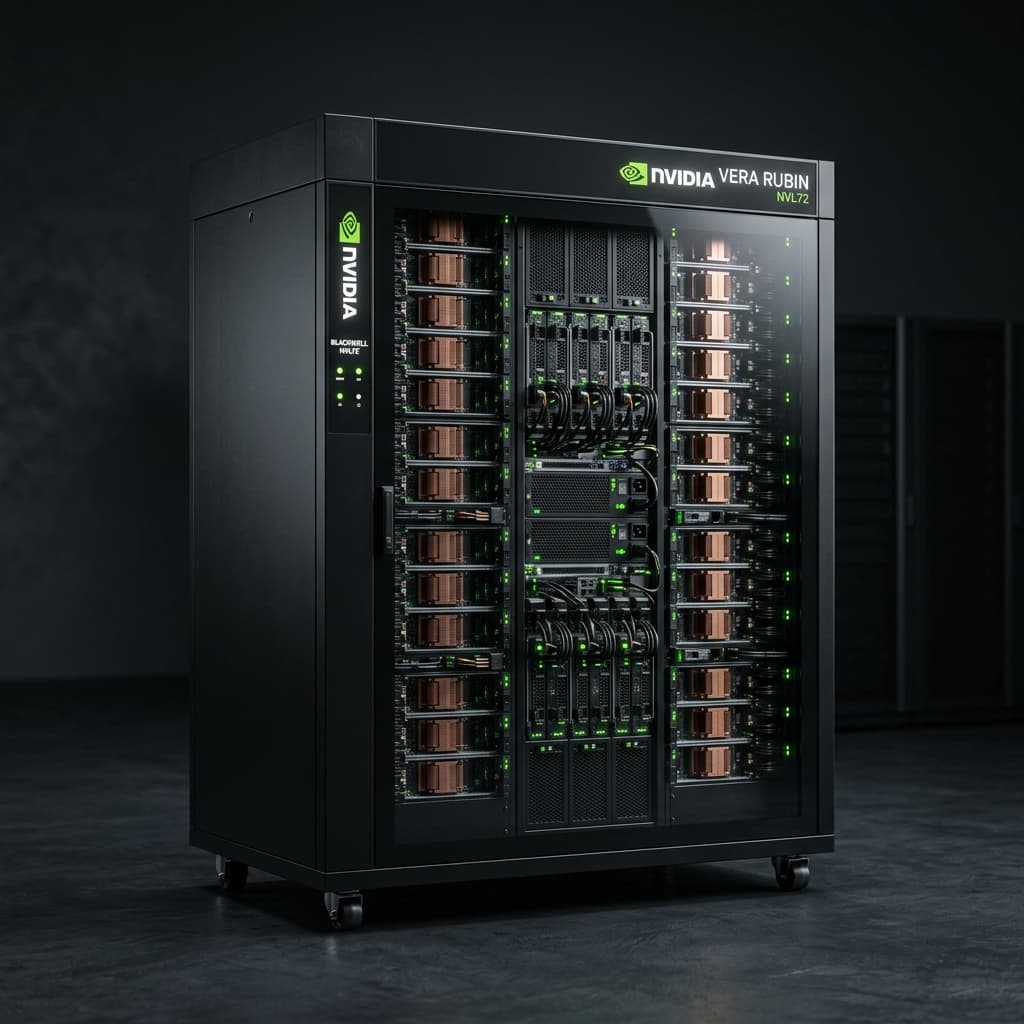
NVIDIA Vera Rubin NVL72
High-performance computing system with 72 NVIDIA Rubin GPUs and 36 NVIDIA Vera CPUs.
Where it wins, where it doesn't
Pros
- Offers up to 9,360 TFLOPS FP32 and 288 PFLOPS FP16/BF16 for high-performance computing.
- Equipped with up to 54 TB of LPDDR5X CPU memory, ensuring ample resources for complex tasks.
- Supports up to 20.7 TB HBM4 GPU memory with 1,400 TB/s bandwidth, ideal for data-intensive applications.
Cons
- High power consumption and cooling requirements make it unsuitable for environments without robust infrastructure.
- Limited networking bandwidth in smaller configurations restricts scalability and flexibility.
- Complex NVLink requirements necessitate a specific setup, complicating deployment and maintenance.
Specifications
- AI Performance—
- Configuration72 NVIDIA Rubin GPUs | 36 NVIDIA Vera CPUs | 2 NVIDIA Rubin GPUs | 1 NVIDIA Vera CPU | 1 NVIDIA Rubin GPU
- CPU—
- CPU Core Count3,168 custom NVIDIA Olympus cores | 6,336 Threads | 88 custom NVIDIA Olympus cores | 176 Threads | -
- CPU MemoryUp to 54 TB LPDDR5X | Up to 1.5 TB LPDDR5X | -
- FP16/BF16³288 PFLOPS | 8 PFLOPS | 4 PFLOPS
- FP329,360 TFLOPS | 260 TFLOPS | 130 TFLOPS
- FP642,400 TFLOPS | 67 TFLOPS | 33 TFLOPS
- FP8/FP6 Training³1,260 PFLOPS | 35 PFLOPS | 17.5 PFLOPS
- GPU—
- GPU Memory | Bandwidth20.7 TB HBM4 | 1,400 TB/s | 576 GB HBM4 | 38.5 TB/s | 288 GB HBM4 | 19.2 TB/s
- GPUs in 100 MW¹40K GPUs
- Inlet Temp45°C
- Memory—
- Networking Bandwidth (Scale-Out)´32.4 TB/s | 0.9 TB/s | 0.45 TB/s
- NVFP4 Inference²3,600 PFLOPS | 100 PFLOPS | 50 PFLOPS
- NVFP4 Training³2,520 PFLOPS | 70 PFLOPS | 35 PFLOPS
- NVIDIA NVLinkSixth Generation
- NVLink Bandwidth216 TB/s | 6 TB/s | 3 TB/s
- NVLink-C2C Bandwidth65 TB/s | 1.8 TB/s | -
- Power—
- Storage—
- TF32³144 PFLOPS | 4 PFLOPS | 2 PFLOPS
- Total NVIDIA + HBM4 Chips1,296 | 30 | 12